Archive for May, 2009

Early Tacoma Bahá’ís – Elizabeth Johnson, Part 2

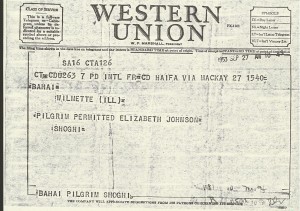
The telegram granting Elizabeth permission to come on pilgrimage

The privilege of making the pilgrimage to the holy places of one’s Faith was one of the highlights of Elizabeth’s life. This was especially true during the ministry of Shoghi Effendi, as pilgrimage also meant the inestimable bounty of meeting the man who was the direct descendant of Bahá’u’lláh and the family of the Báb, her spiritual leader, and infallible guide. She wrote to the Guardian in January, 1953, asking for permission to come on pilgrimage, and informing him of her intention to attend the Stockholm Conference that summer. The Guardian’s secretary replied to her in a letter dated in March, telling Elizabeth that, because of the long waiting list, it would not be possible for her to come to Haifa before the Conference, but that he would let her know when it would be possible to do so; and also expressing happiness with her intention to attend the Conference.  


            The request to go on pilgrimage went directly to the World Center in Haifa. The approval from Haifa went by cable to the National Spiritual Assembly, who in turn relayed the permission to Elizabeth. Permission to go on pilgrimage was granted in September and was for January, 1954. Late that month, Elizabeth received a letter from the Office of the Secretary of the National Spiritual Assembly, along with the cable from the Guardian. The economical text of the cable read simply, “PILGRIM PERMITTED ELIZABETH JOHNSON” and was signed “SHOGHI”. The letter from the National office was signed by the Secretary, Horace Holley, who was then also a Hand of the Cause of God. Elizabeth made her arrangements directly with Haifa, and she was granted approval, by cable, to leave for Haifa the middle of January.          


            One of the indications of how small the number of pilgrims was in the 1950’s, compared to today, and how few the number of followers of Bahá’u’lláh, is a letter sent to Elizabeth with regard to her travel arrangements. She planned to visit London on her return, and had written directly to the NSA of the British Isles for recommendations as to hotel accommodations. The National Spiritual Assembly sent her a five paragraph reply, nearly a full page, giving her several recommendations. It suggested, for example, trying the Alexa Hotel, noting that is the hotel where the NSA and Committee members often stay, but informing her that it does not have a lift. The friendly letter said that four pilgrims had just returned to their country, the first in many months, and they were anxiously waiting to hear what they had to say. The letter concluded by requesting that she let them know when and how long she would be in London, so that the friends there would be able to meet her and hear the comments of the Guardian. It was signed by the NSA Secretary, John Ferraby, who would be appointed a Hand of the Cause of God in 1957. The friends were always eager to hear the Guardian’s words, especially at this time, the beginning of the Ten Year Crusade.


            Elizabeth arrived in Israel on Monday morning, January 18, after what was surely a tiring journey. Air travel took much longer then because of the need for frequent refueling stops. She left New York the evening of the 16th, and made stops in Shannon, Paris, Zurich, Rome, and Athens (all on the same flight) en route to Tel Aviv.  She was certainly eager to get there, since she did not stay over at any of her stops! Upon settling at her hotel in Haifa, she cabled her husband, John, of her safe arrival.
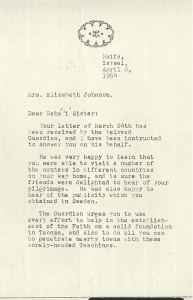
 

A letter from the Guardian, page 1


            Pilgrimage is a personal, intimate experience that cannot adequately be conveyed in words. Bahá’ís read the history of their Faith and the associations of their holy places in Akká and Haifa with the lives of Bahá’u’lláh, ‘Abdu’l-Bahá, their family, the remains of the Báb, and the many early believers. It becomes a part of every Bahá’í’s history. Pilgrims can walk where they walked and see what they saw. They can see how the holy places have been transformed and beautified under the Guardian’s care. And most of all, they can visit and pray at those most holy places, the resting spots of the Central Figures of their Faith. Elizabeth, like many pilgrims during the lifetime of the Guardian, left Pilgrim Notes of some of her experiences.
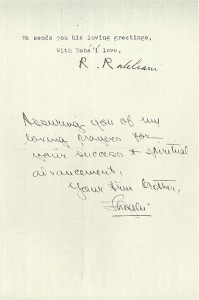
           

A letter from the Guardian, page 2


            She was a people person, and her Pilgrim Notes reflect that. She does not tell about her thoughts or emotions, or comment on her visits to the holy places or her sight-seeing trips. She talks about people she met – conversing with a Jewish man on the plane whose family had perished in the holocaust, and enjoying lunch at the Pilgrim House with Ruhiyyih Khanum, Sylvia Ioas, and Honor Kempton. Mostly, of course, she comments on her meeting Shoghi Effendi, the Guardian of the Bahá’í Faith. The Guardian regularly invited pilgrims to sit at the dinner table with him and with those who served him in Haifa – the members of the International Bahá’í Council and the Hands of the Cause. They would be privileged to hear the Guardian’s assistants share with him the news of the day’s labors and his advice and instructions to them for the next day. And, Shoghi Effendi would speak to the pilgrims directly, answering their questions, telling them what the Bahá’ís must do to promote the Word of God, and sharing with them his vision. It is these comments directed to the pilgrims that fill the brief pages of Elizabeth’s notes.


            Elizabeth’s thoughtfulness to others is revealed in the correspondence that followed her pilgrimage. She stopped in Rome on the way home and visited the Hand of the Cause Ugo Giachery and his wife, Angeline, at their home, where she also enjoyed visiting with Bahá’ís at a fireside and luncheon. Her warm letter to Mr. and Mrs. Giachery, thanking them for their hospitality, expressed her sorrow that they could not use the stockings that she left them, and she also says that she would like to know about the watch, hoping that it could be fixed. Who else would leave stockings and a watch to a Hand of the Cause and his wife?


            Jessie and Ethel Revell each wrote separate letters to her recalling her pilgrimage. Jessie writes, “After you left, there was a big vacancy here – we all miss you very much.” She goes on to say that she wore the scarf that Elizabeth gave her and that it was beautiful and a cheerful reminder of her. And she concludes by saying, “We miss your good cake and rolls, etc.”  Ethel wrote Elizabeth twice (both responses to her letters). One letter, written two years later while on vacation in Malta, comments on activities and people, and also says to Elizabeth, “Don’t worry about your not making an angel pie while you were in Haifa. What we did have of your baking was simply delicious.” How many pilgrims took the time to bake for the Guardian and his busy staff? Elizabeth must have left quite an impression with her baking, to be remembered so well two years later.


            Elizabeth was faithful to the Guardian in her teaching efforts in the Tacoma area. She wrote her (presumably) fourth and final letter to him in January, 1957, keeping him apprised of her efforts. The reply, by the Guardian’s Secretary (Hand of the Cause Leroy Ioas), expresses pleasure with her teaching work and asks her to write to the friends in Korea so that they may contact a master sergeant who became a Bahá’í through Elizabeth’s efforts. Mr. Ioas also tells her that the Guardian wishes her to continue her correspondence with the friends in Sweden, France, and the Faroe Islands. He concludes by reminding her that “Spiritual development comes through teaching the Faith, as it attracts the quickening power of the Holy Spirit.” Enclosed with the letter was a receipt for a contribution to the Fund, which was signed, as usual, “Shoghi”. Such was the burden on the Guardian, that he personally signed the many receipts even for modest contributions – but one can imagine the pleasure and confirming power bestowed on the happy contributor, to have the receipt so signed.
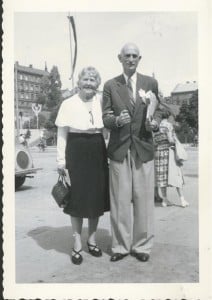
           

Hand of the Cause Ugo Giachery with his dear wife, Angeline, taken by Elizabeth at a conference in Stockholm in 1953.


Elizabeth received four letters from the Guardian’s secretaries on his behalf, in reply to her letters. The first three had a postscript in the handwriting of  Shoghi Effendi, which was something about which she was always proud. The first one was in reply to her request to go on pilgrimage. The Guardian wrote: “Assuring you of my loving prayers for your success in the service of our beloved Faith. Your true brother, Shoghi”.  The second letter was a follow-up to the first one, coming just one month later, informing Elizabeth that the Guardian knows nothing about a certain Dr. Amir Rouhi from Iran, that he is neither a Bahá’í nor related to Bahá’u’lláh, and that it is better to avoid him. We have no other information about this Dr. Rouhi or why Elizabeth would write to the Guardian about him – one suspects that the real reason was the desire to enjoy again the excitement of receiving a letter from the Guardian. The third letter came to Elizabeth after her pilgrimage and return home. The Guardian’s secretary expresses Shoghi Effendi’s happiness to learn that she was able to visit a number of centers in different countries on the way home and that she was able to obtain publicity for the Faith in Sweden. The letters goes on to say: “The Guardian urges you to use every effort to help in the establishment of the Faith on a solid foundation in Tacoma, and also to do all you can to penetrate nearby towns with these sorely-needed teachings.”


            That Elizabeth would receive personal responses to her letters gives us a very small hint at the great burden of work facing the Guardian and the small staff at the World Center in just reading and answering the correspondence. There were no computers then. Each letter had to be typed by hand. And, Shoghi Effendi would take the time to append a few personal words of encouragement to so many of the letters. This tells us something of the importance that he placed in the teaching efforts of each of the faithful followers of Bahá’u’lláh, that he would take the time to do this so regularly for so many years.

Early Tacoma Bahá’ís – Elizabeth Johnson, Part 1

Elizabeth Johnson at age 25

“It’s wonderful to be able to ask this kind of service and immediately get a ‘yes’ answer, and know it’s going to be done.” A life of devotion and service is summarized in

this line from a postscript of a letter, expressing personal and heartfelt appreciation for publicity arrangements made for a Bahá’í visitor.  Filed away, unseen and unknown, this “thank you” stands, for us, as  tribute to one of the homefront pioneers and founders of the Bahá’í Faith in Tacoma. Elizabeth Johnson, the latter half of her long life, served her Lord to sustain and build the religious community of her adopted town. She did the ordinary, unpretentious, little things that need to be done. She helped set up meetings for guest speakers. She wrote and delivered news items or announcements of events to the daily newspaper. She corresponded with pioneers of the Faith she had never met who were serving the Faith in places she had never been. She helped the ill and needy. 


            Little is know of the first half of Elizabeth’s life. Born Elizabeth Bergren in Sweden on June 4, 1895, she immigrated to the United States in 1916 and worked as a domestic servant in the homes of Chicago families. She was five feet six inches tall and had brown hair and blue eyes. We don’t know if she had family in the United States prior to her arrival, although years later she did have sisters living in Minneapolis.  Who her friends were, what she did in her leisure time, whether she had a boyfriend or loved someone, what her ambitions may have been and what her disappointments were: these important and personal aspects of the first forty-five years of her life we know nothing about. And, perhaps it does not matter that we don’t know. We all live with the struggles and pleasures and pains of life. What Elizabeth did have in her life that makes her worth remembering is that she came to recognize her Lord and spent her life serving Him and helping others. This began about 1940.


            That great and silent teacher of the Faith, the Temple in Wilmette (a suburb of Chicago) may have been what first attracted her curiosity to the Faith. She saw it being built a little at a time as the finances of the small North American Bahá’í community allowed. How she came to inquire about the Faith and what type of meeting she first attended, we don’t know. Her teacher was an early and well-known American believer, Albert Windust. But, her spiritual father, a man who remained special to her for the rest of her life, was Harvey Nied. 


            We have the following information from Elizabeth about her spiritual forebears. Harvey Nied entered the Faith about 1939, while living in Florida and making a living doing Swedish massage. He studied the Faith from Dr. Zia Bagdadi and later in Chicago from Albert Windust. In 1940 Mr. Nied became ill while attending a Bahá’í summer school in Flint, Michigan. After being first taken to a county hospital, he was transferred to a Veterans Affairs hospital for mental patients in Elgin, Illinois. Mr. Nied’s sister,

with help from Elizabeth, was able to have him released from the V.A. hospital so that he could receive treatment elsewhere, and also arranged for him to receive social security benefits. Elizabeth helped care for him on behalf of his legal guardian by taking him to the doctor, buying his clothes, and doing other little things for him to make his life more pleasant.   


            Elizabeth moved to Tacoma in 1943, and Mr. Nied (apparently afterward) moved to Portland, Oregon to work at a shipyard. Sometime later he was found in a mission in Seattle, unable to care for himself. He had a legal guardian from the LaSalle Bank who contacted Elizabeth and asked her to help find him. Apparently she did so, for in 1941 she was able to help him obtain a veteran’s pension of $40 per month. The LaSalle Bank served as the guardian of his money. This is a brief and incomplete history of two dear

friends. It does create questions. Presumably, Elizabeth left for the West Coast before Mr. Nied. Did Mr. Nied go to the West Coast because his friend, Elizabeth, was there? If he did, then why didn’t he go to Tacoma? And how was Elizabeth able to find him? We shall never know.


            Eventually, Harvey Nied was admitted into the V.A. hospital for mental patients near Tacoma (at American Lake in Lakewood, Washington). At one time he was boarded out to a family, but was re-admitted into the hospital after he walked away from them. He was moved to a nursing home in 1965, receiving a V.A. pension and social security, and spent the rest of his life in various nursing homes. Elizabeth (and her husband, John, until his passing) would go see him often and help care for him. For years, she did numerous things to make his life more comfortable: she brought him food, fed him when he could not feed himself, did his laundry, and washed him. Harvey Eugene Nied, born May 2, 1892, left this world on November 27, 1972, and following a funeral service in Tacoma was laid to rest at the Willamette National Cemetery in Oregon. 


            This brief account of the life of Harvey Nied, together with the fact that, late in her life, Elizabeth was motivated to record something for posterity about the man who was her spiritual father, tells us as much about Elizabeth as it does about Mr. Nied. She was devoted to him, and she loved and cared for the man who helped her find the Bahá’í Faith. Others were aware of her devotion. One friend, consoling her over Mr. Nied’s passing, wrote that “Though he was alone in the isolated world of the mind, he could not have had a more devoted friend to see him through than you, Elizabeth. For twenty-eight years you have been his only mainstay here in Tacoma, as I know. Only you understood what a gentle, well educated gentlemen, Harvey Nied was and only you, Elizabeth, understood in some spiritual way what bound you to him, to help and stand by him.”


Elizabeth with unidentified man. Possibly Chicago 1932.


            Elizabeth became a Bahá’í in 1941 or 1942, while living in Chicago. She left there in 1943 and moved to Tacoma to help with the teaching and proclamation efforts. She married John A. Johnson, a railroad employee, in Tacoma that same year, marrying for the first time (as far as we know) at age 48.  She did, however, maintain her ties to Chicago. She may have attended the Bahá’í Centenary Banquet in that city, because her papers include a program card from that banquet: guest speakers included Albert Windust and Elsie Austin. And, she visited her life-long friend from that area, Betty Edwards, in 1950, as indicated by a clipping from a mimeographed Bahá’í newsletter that she kept that referred to her visit.  Undated newspaper and magazine clippings, which may be from 1947, show her husband, John, a train fireman, dressed in white tie, tails, and top hat, posing proudly with the conductor and engineer on the new Olympian Hiawatha, a new passenger train that the reader is told will operate on a 45 hour schedule between Chicago and Seattle. Did John Johnson’s career have something to do with how he and Elizabeth met and why she decided to marry him? Did her marriage allow this frugal Swede to make trips to Chicago at a reduced fare? The decision to marry can be complex. One can only speculate.


            Elizabeth collected newspaper clippings about Bahá’í activities in Tacoma and elsewhere, especially during the late 1940’s and throughout the 1950’s. There are so many clippings, in fact, that she may have collected virtually every item that appeared in the newspaper about the Faith. Most of them probably got there because of her active work.

Elizabeth knew how to get things done. She often delivered some of her baked goods to the appropriate newspaper staff, along with that valuable item about the Faith, in order to enhance the likelihood of the item being published.


            The articles reveal her interest in and commitment to the affairs of the Faith. Here are some examples. The assassination of Count Folke Bernadotte (a nephew of the King of Sweden) in Jerusalem in September, 1948, where he was working to settle the Arab-Israeli dispute on behalf of the United Nations, provoked Elizabeth to write a letter about his death that appeared in Tacoma’s daily paper, The News Tribune. She writes several paragraphs condemning the senseless violence, and concludes by mentioning Bahá’u’lláh and quoting briefly from His Writings. Another example: the society column of the Tacoma newspaper for October 18, 1949, relates that the 130th anniversary of the Birth of the Báb will be held at her home on Thursday at 8 p.m. at 414 South Tacoma Avenue.  Also: The News Tribune’s June 6, 1955 edition carries an article about Elizabeth, as secretary of the Tacoma Bahá’ís, writing a letter to President Eisenhower asking him to use his influence to prevent further persecutions of Bahá’ís in Iran.  Many newspaper articles announce local holy day observances and guest speakers, and there are occasional letters to the editor by Elizabeth.


            She was not reluctant to defend her beloved homeland. Elizabeth was proud of her Swedish heritage. A letter to the editor appears in the August 3, 1949 Tacoma newspaper in which she defends her country against a perceived slight by an Anthony J. Corvin, made in another letter to the editor that appeared in the July 27 edition. The nature of the insult is not clear; apparently he said something uncomplimentary about the Italians, Irish, Jews, Slavs, and the Swedish people. Elizabeth was shocked, however, and her  proud defense is stirring, praising the Swedes’ cleanliness, healthful habits, thrift, and fresh food: “I was told in Chicago that travelers in Sweden found smorgasbord out of this world and parks very clean. You don’t have nerve to throw your cigaret in the parks. Swedish people don’t like installments on automobiles so they go bicycling. If you go to Stockholm, you find the 91-year-old King bicycling.”; and “Where in Sweden will you find vermin-ridden huts and sour soups.”  She concludes her patriotic defense by appealing to universal brotherhood, stating that “I am looking for a universal language, one common script, the unity of thought in world’s undertakings, the unity of religion, the unity of nations, the unity of races, making of all that dwell on earth, peoples and kindreds of one race.” That plain spokenness was characteristic of Elizabeth.

Make Thy beauty to be my food

Pilgrims enjoy a floral arrangement in Haifa, Israel.

Photo by Matt Rizzo


O my Lord! Make Thy beauty to be my food, and Thy presence my drink, and Thy pleasure my hope, and praise of Thee my action, and remembrance of Thee my companion, and  the power of Thy sovereignty my succorer, and Thy habitation my home, and my dwelling-place the seat Thou hast sanctified from the limitations imposed upon them who are shut out as by a veil from Thee.

Thou art, verily, the Almighty, the All-Glorious, the Most Powerful.

                                                                                                             Bahá’u’lláh


Ponder then in thine heart: Matters being such as thou dost witness, and as We also witness, where canst thou flee, and with whom shalt thou take refuge? Unto whom wilt thou turn thy gaze? In what land shalt thou dwell and upon what seat shalt thou abide? In what path shalt thou tread and at what hour wilt thou find repose? What shall become of thee in the end? Where shalt thou secure the cord of thy faith and fasten the tie of thine obedience? By Him Who revealeth Himself in His oneness and Whose own Self beareth witness to His unity!  Should there be ignited in thy heart the burning brand of the love of God, thou wouldst seek neither rest nor composure, neither laughter nor repose, but wouldst hasten to scale the highest summits in the realms of divine nearness, sanctity, and beauty. Thou wouldst lament as a soul bereaved and weep as a heart filled with longing. Nor wouldst thou repair to thy home and abode unless God would lay bare before thee His Cause.

                                                                                                            Bahá’u’lláh


O thou seeker after the Kingdom! Every divine Manifestation is the very life of the world, and the skilled physician of each ailing soul. The world of man is sick, and that competent Physician knoweth the cure, arising as He doth with teachings, counsels and admonishments that are the remedy for every pain, the healing balm to every wound. It is certain that the wise physician can diagnose his patient’s needs at any season, and apply the cure. Wherefore, relate thou the Teachings of the Abha Beauty to the urgent needs of this present day, and thou wilt see that they provide an instant remedy for the ailing body of the world. Indeed, they are the elixir that bringeth eternal health.

                                                                                                             ‘Abdu’l-Bahá

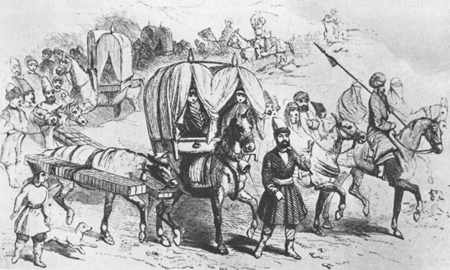
Bahá’u’lláh Departs from Baghdad

The howdah was a form of transportaton used mainly for women and children on long voyages.

Image courtesy of www.bahai-biblio.org.

‘Abdu’l-Bahá, in His Will and Testament, says this about Shoghi Effendi, in His appointment of him to be the Guardian of the Faith following His passing:

O my loving friends! After the passing away of this wronged one, it is incumbent upon the Aghsan (Branches), the Afnan (Twigs) of the Sacred Lote-Tree, the Hands (pillars) of the Cause of God and the loved ones of the Abha Beauty to turn unto Shoghi Effendi — the youthful branch branched from the two hallowed and sacred Lote-Trees and the fruit grown from the union of the two offshoots of the Tree of Holiness, — as he is the sign of God, the chosen branch, the Guardian of the Cause of God, he unto whom all the Aghsan, the Afnan, the Hands of the Cause of God and His loved ones must turn. He is the Interpreter of the Word of God and after him will succeed the first-born of his lineal descendants.

Shoghi Effendi, the true Sign of God (Ayatollah), in his masterful exposition of the history of the Faith, God Passes By, relates to us Bahá’u’lláh’s departure from Baghdad and the first stage of His journey of exile to Istanbul as a prisoner of the Ottoman Empire:

The departure of Bahá’u’lláh from the Garden of Ridvan, at noon, on the 14th of Dhi’l-Qa’dih 1279 A.H. (May 3, 1863), witnessed scenes of tumultuous enthusiasm no less spectacular, and even more touching, than those which greeted Him when leaving His Most Great House in Baghdad. “The great tumult,” wrote an eyewitness, “associated in our minds with the Day of Gathering, the Day of Judgment, we beheld on that occasion. Believers and unbelievers alike sobbed and lamented. The chiefs and notables who had congregated were struck with wonder. Emotions were stirred to such depths as no tongue can describe, nor could any observer escape their contagion.”

Mounted on His steed, a red roan stallion of the finest breed, the best His lovers could purchase for Him, and leaving behind Him a bowing multitude of fervent admirers, He rode forth on the first stage of a journey that was to carry Him to the city of Constantinople. “Numerous were the heads,” Nabil himself a witness of that memorable scene, recounts, “which, on every side, bowed to the dust at the feet of His horse, and kissed its hoofs, and countless were those who pressed forward to embrace His stirrups.” “How great the number of those embodiments of fidelity,” testifies a fellow-traveler, “who, casting themselves before that charger, preferred death to separation from their Beloved! Methinks, that blessed steed trod upon the bodies of those pure-hearted souls.” “He (God) it was,” Bahá’u’lláh Himself declares, “Who enabled Me to depart out of the city (Baghdad), clothed with such majesty as none, except the denier and the malicious, can fail to acknowledge.” These marks of homage and devotion continued to surround Him until He was installed in Constantinople. Mirza Yahya, while hurrying on foot, by his own choice, behind Bahá’u’lláh’s carriage, on the day of His arrival in that city, was overheard by Nabil to remark to Siyyid Muhammad: “Had I not chosen to hide myself, had I revealed my identity, the honor accorded Him (Bahá’u’lláh) on this day would have been mine too.”

The same tokens of devotion shown Bahá’u’lláh at the time of  His departure from His House, and later from the Garden of Ridvan, were repeated when, on the 20th of Dhi’l-Qa’dih (May 9, 1863), accompanied by members of His family and twenty-six of His disciples, He left Firayjat, His first stopping-place in the course of that journey. A caravan, consisting of fifty mules, a mounted guard of ten soldiers with their officer, and seven pairs of howdahs, each pair surmounted by four parasols, was formed, and wended its way, by easy stages, and in the space of no less than a hundred and ten days, across the uplands, and through the defiles, the woods, valleys and pastures, comprising the picturesque scenery of eastern Anatolia, to the port of Samsun, on the Black Sea. At times on horseback, at times resting in the howdah reserved for His use, and which was oftentimes surrounded by His companions, most of whom were on foot, He, by virtue of the written order of Namiq Pasha, was accorded, as He traveled northward, in the path of spring, an enthusiastic reception by the valis, the mutisarrifs, the qa’im-maqams, the mudirs, the shaykhs, the muftis and qadis, the government officials and notables belonging to the districts through which He passed. In Karkuk, in Irbil, in Mosul, where He tarried three days, in Nisibin, in Mardin, in Diyar-Bakr, where a halt of a couple of days was made, in Kharput, in Sivas, as well as in other villages and hamlets, He would be met by a delegation immediately before His arrival, and would be accompanied, for some distance, by a similar delegation upon His departure. The festivities which, at some stations, were held in His honor, the food the villagers prepared and brought for His acceptance, the eagerness which time and again they exhibited in providing the means for His comfort, recalled the reverence which the people of Baghdad had shown Him on so many occasions.

Twelve magical days in 1863

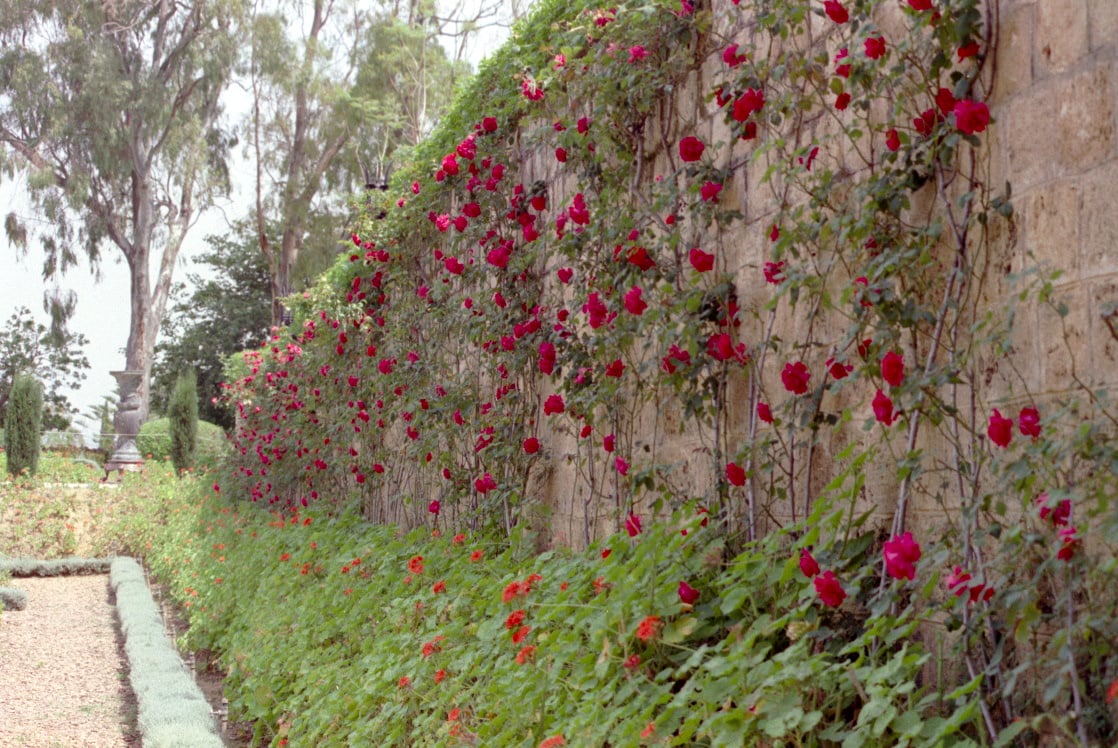
A wall of roses at Bahjí, the location of Bahá'u'lláh's Shrine, the point of adoration for the Bahá'ís of the world


Shoghi Effendi, the Guardian of the Bahá’í Faith, relates to us in God Passes By those magical days for Bahá’u’lláh’s followers in the Garden of Ridván in Baghdad, those few days in which they were so privileged to spend in His company, that twelve-day period in which He announced His mission to His followers, April 21 to May 2, 1863:

Already the shadow of that great oncoming event had fallen upon the colony of exiles, who awaited expectantly its consummation. As the year “eighty” steadily and inexorably approached, He Who had become the real leader of that community increasingly experienced, and progressively communicated to His future followers, the onrushing influences of its informing force. The festive, the soul-entrancing odes which He revealed almost every day; the Tablets, replete with hints, which streamed from His pen; the allusions which, in private converse and public discourse, He made to the approaching hour; the exaltation which in moments of joy and sadness alike flooded His soul; the ecstasy which filled His lovers, already enraptured by the multiplying evidences of His rising greatness and glory; the perceptible change noted in His demeanor; and finally, His adoption of the taj (tall felt head-dress), on the day of His departure from His Most Holy House — all proclaimed unmistakably His imminent assumption of the prophetic office and of His open leadership of the community of the Báb’s followers.

“Many a night,” writes Nabil, depicting the tumult that had seized the hearts of Bahá’u’lláh’s companions, in the days prior to the declaration of His mission, “would Mirza Aqa Jan gather them together in his room, close the door, light numerous camphorated candles, and chant aloud to them the newly revealed odes and Tablets in his possession. Wholly oblivious of this contingent world, completely immersed in the realms of the spirit, forgetful of the necessity for food, sleep or drink, they would suddenly discover  153  that night had become day, and that the sun was approaching its zenith.”

Of the exact circumstances attending that epoch-making Declaration we, alas, are but scantily informed. The words Bahá’u’lláh actually uttered on that occasion, the manner of His Declaration, the reaction it produced, its impact on Mirza Yahya, the identity of those who were privileged to hear Him, are shrouded in an obscurity which future historians will find it difficult to penetrate. The fragmentary description left to posterity by His chronicler Nabil is one of the very few authentic records we possess of the memorable days He spent in that garden. “Every day,” Nabil has related, “ere the hour of dawn, the gardeners would pick the roses which lined the four avenues of the garden, and would pile them in the center of the floor of His blessed tent. So great would be the heap that when His companions gathered to drink their morning tea in His presence, they would be unable to see each other across it. All these roses Bahá’u’lláh would, with His own hands, entrust to those whom He dismissed from His presence every morning to be delivered, on His behalf, to His Arab and Persian friends in the city.” “One night,” he continues, “the ninth night of the waxing moon, I happened to be one of those who watched beside His blessed tent. As the hour of midnight approached, I saw Him issue from His tent, pass by the places where some of His companions were sleeping, and begin to pace up and down the moonlit, flower-bordered avenues of the garden. So loud was the singing of the nightingales on every side that only those who were near Him could hear distinctly His voice. He continued to walk until, pausing in the midst of one of these avenues, He observed: ‘Consider these nightingales. So great is their love for these roses, that sleepless from dusk till dawn, they warble their melodies and commune with burning passion with the object of their adoration. How then can those who claim to be afire with the rose-like beauty of the Beloved choose to sleep?’ For three successive nights I watched and circled round His blessed tent. Every time I passed by the couch whereon He lay, I would find Him wakeful, and every day, from morn till eventide, I would see Him ceaselessly engaged in conversing with the stream of visitors who kept flowing in from Baghdad. Not once could I discover in the words He spoke any trace of dissimulation.”

As to the significance of that Declaration let Bahá’u’lláh Himself reveal to us its import. Acclaiming that historic occasion as the “Most Great Festival,” the “King of Festivals,” the “Festival of God,”  He has, in His Kitáb-i-Aqdas, characterized it as the Day whereon “all created things were immersed in the sea of purification,” whilst in one of His specific Tablets, He has referred to it as the Day whereon “the breezes of forgiveness were wafted over the entire creation.” “Rejoice, with exceeding gladness, O people of Baha!”, He, in another Tablet, has written, “as ye call to remembrance the Day of supreme felicity, the Day whereon the Tongue of the Ancient of Days hath spoken, as He departed from His House proceeding to the Spot from which He shed upon the whole of creation the splendors of His Name, the All-Merciful… Were We to reveal the hidden secrets of that Day, all that dwell on earth and in the heavens would swoon away and die, except such as will be preserved by God, the Almighty, the All-Knowing, the All-Wise. Such is the inebriating effect of the words of God upon the Revealer of His undoubted proofs that His pen can move no longer.” And again: “The Divine Springtime is come, O Most Exalted Pen, for the Festival of the All-Merciful is fast approaching…. The Day-Star of Blissfulness shineth above the horizon of Our Name, the Blissful, inasmuch as the Kingdom of the Name of God hath been adorned with the ornament of the Name of Thy Lord, the Creator of the heavens…. Take heed lest anything deter Thee from extolling the greatness of this Day — the Day whereon the Finger of Majesty and Power hath opened the seal of the Wine of Reunion, and called all who are in the heavens and all who are on earth…. This is the Day whereon the unseen world crieth out: ‘Great is thy blessedness, O earth, for thou hast been made the footstool of thy God, and been chosen as the seat of His mighty throne’ …Say … He it is Who hath laid bare before you the hidden and treasured Gem, were ye to seek it. He it is who is the One Beloved of all things, whether of the past or of the future.” And yet again: “Arise, and proclaim unto the entire creation the tidings that He who is the All-Merciful hath directed His steps towards the Ridvan and entered it. Guide, then, the people unto the Garden of Delight which God hath made the Throne of His Paradise… Within this Paradise, and from the heights of its loftiest chambers, the Maids of Heaven have cried out and shouted: ‘Rejoice, ye dwellers of the realms above, for the fingers of Him Who is the Ancient of Days are ringing, in the name of the All-Glorious, the Most Great Bell, in the midmost heart of the heavens. The hands of bounty have borne round the cups of everlasting life. Approach, and quaff your fill.'” And finally: “Forget the world of creation, O Pen, and turn Thou towards the face of Thy Lord, the Lord of all names. Adorn, then, the world  with the ornament of the favors of Thy Lord, the King of everlasting days. For We perceive the fragrance of the Day whereon He Who is the Desire of all nations hath shed upon the kingdoms of the unseen and of the seen the splendors of the light of His most excellent names, and enveloped them with the radiance of the luminaries of His most gracious favors, favors which none can reckon except Him Who is the Omnipotent Protector of the entire creation.”