RSS Feed for Early Tacoma Bahá’ísEarly Tacoma Bahá’ís

Early Tacoma Bahá’ís – Nettie Asberry

Nettie Asberry c. 1909

Nettie J. Craig Asberry


Part 1. Biography


          This brief account cannot begin to do justice to the long and accomplished life of Nettie Asberry, a woman who was well educated, intelligent, highly musically gifted, and always socially progressive and active in the pursuit of human rights.


Nettie Asberry was born July 15, 1865, in Leavenworth, Kansas, where she went to a segregated school, but later attended the state university, which was free to all races. She began studying the piano where she was eight, showed remarkable ability and took her doctor’s degree in music from the Kansas State Conservatory of music.


During her childhood she remembers seeing Susan B. Anthony when Mrs. Anthony came to visit her brother, D. R. Anthony, editor of the Leavenworth Times.  At thirteen years of age, Nettie was secretary of an adult Susan B. Anthony Club. Before coming to the Northwest, Mrs. Asberry taught music in Kansas City and in Denver and gave much time to playing for churches and directing choirs.

Her family moved to Seattle in 1890, becoming interested in the area after reading news of the Seattle fire of 1889. After three years in Seattle’s music world, she came to Tacoma and married Henry J. Asberry, proprietor of a barbershop. He died in 1939. In 1909, residing in Tacoma, she was described as a music teacher of rare ability who always had a large number of pupils, and was regarded as one of Tacoma’s expert pianists and a woman of great accomplishment, speaking French and German fluently. She taught piano to students of all races for more than 50 years. Very socially active and progressive, she helped found the Tacoma Chapter of the National Association for the Advancement of Colored People, said to be the first chapter west of Kansas City.


Nettie Asberry died at the age of 103, spending her last few years in a nursing home in Tacoma. Tacoma Mayor A.L. Rasmussen declared May 11, 1968 Nettie Asberry Day and a memorial was planned for her.


Source of Part 1: Who We Are, An informal history of Tacoma’s Black Community before World War I; written and edited by Gary Fuller Reese, Tacoma Public Library, February 1992. Its main source is The (Tacoma) News Tribune and earlier Tacoma newspapers.

Part 2.  Nettie Asberry as a Bahá’í


            Most 79 year-olds are fairly well set in their ways. Their mental and physical powers are diminished. They no longer have the curiosity or ambition or vitality that they once enjoyed. Whatever course they have taken in life is the course that they are on and will remain on, content or not, as they glide toward life’s nearing horizon. One’s values and practices have long since been solidified, especially for fundamentals such as religion and worship. At 79 years of age, Nettie Asberry did a remarkable thing: she changed her religion and resigned from her church. She found Bahá’u’lláh and became one of His followers. This happened in 1944 or ’45 through the friendship of two new Bahá’ís in town, Harry and Marjorie Taylor, who were members of the first Spiritual Assembly of the Bahá’ís of Tacoma, which was founded in November 1943.

Nettie Asberry is seated in the center.

           She immediately became an active member of the Faith, attending meetings and writing letters to the editor of the local newspaper. In April 1945 the local Bahá’ís sponsored a public symposium on “The Oneness of Mankind” that featured Mrs. Ernest Tanner of the Interracial Council and Nettie Asberry, who was then Treasurer of the local N.A.A.C.P. With an eye on the Resurrection of Christ and the Easter Holy Day, she wrote a letter to the editor in April 1946 that boldly compared the martyrdom of the Báb with the crucifixion of Christ, detailing the circumstances of the Báb’s martyrdom. Underlying her lifelong battle against racism, her letter began with this pointed statement: “On the eve of Passion week, came today the announcement from an Eastern weekly that the Federal Council of Churches has backed an anti-segregation plan. This pronouncement of the Federal Council, though coming several centuries late, is nevertheless welcome news.”  Her letters to the editor promoted the Faith by easily relating its principles to like-minded causes and events. Her February 1947 letter drew attention to Race Relations Week and Brotherhood Week. First, she commented that similar principles were found in all religions – naming Confucius, Buddha, Moses, Jesus, Mohammad, and Bahá’u’lláh. Next, she referred to ‘Abdu’l-Bahá’s visit to America in 1912 and quoted His statement that “Religion is an attitude toward God reflected in life by mankind” and finishing with words from His prayer for America.

 Nettie Asberry is a featured speaker for the Bahá'ís

            Between 1945 and 1959 she was elected to the Assembly on ten occasions, sometimes serving as Secretary or Recording Secretary. Elizabeth Johnson was one of her good friends, and would often pick her up and drive her to Feast, Holy Days, and other meetings.


            Nettie Asberry was, naturally, less active as she became older. At the age of 97 she suffered a stroke and was admitted to a nursing home. A bedridden condition, however, did not prevent her from seizing upon opportunities to promote the Faith. Her 100th birthday was celebrated with an article and photograph in the local newspaper, and the Faith was mentioned. A newspaper photograph showed her, in bed, posing with Eulalia Bobo (the sister of heavyweight boxing champion Joe Louis) in 1967 while Ms. Bobo was visiting Tacoma as part of a nationwide speaking tour for the Faith.


            Nettie Asberry did not become acquainted with the Faith until 1944, Nettie Asberry plaque in Tacomaat an advance age, but she is connected to the first glimmering mention of the Faith of Bahá’u’lláh in North America.  Gladys Clark, a member of the Tacoma Spiritual Assembly, wrote a biographical sketch about her shortly after her death. Her notes record the remarkable statement that Mrs. Asberry attended the World Parliament of Religions in Chicago in 1893, where the Faith was first mentioned on the continent. Mrs. Clark states that her notes are based on extensive conversations with Mrs. Asberry. While there is no way to know exactly what Mrs. Asberry said or the accuracy of her memory, some worthwhile comments can be made. Nettie Asberry was a well educated, intelligent woman, spiritually minded and keenly interested in human rights. This auspicious event would almost certainly have captured her interest. It and the much greater event, the World’s Fair, held in Chicago at that time, were, in fact, announced in Tacoma daily newspapers at the time, and those newspapers did contain advertisements of direct train service from Tacoma to Chicago. Did she actually go to Chicago or attend the World Parliament? There are no records of attendance at the World Parliament, so it is unlikely that it will be possible to verify her attendance. She may have actually first heard of the Faith in Tacoma. The Tacoma Daily News of October 21, 1893 (shortly after the Parliament concluded) contains an announcement that the Rev. Alfred W. Martin will present ten free lectures, one each week, at the First Free Church, on the world’s great religions (presumably based upon information from the World Parliament). The subject and date of each lecture is listed. The lecture for December 28, 1893 is on “Mohammedanism – the religion of Turkey and Arabia, etc.”.  The large size of and detailed information in the announcement suggest that a good turnout was expected. It is certainly possible that the Bahá’í Faith and Bahá’u’lláh were briefly mentioned that evening. If one accepts the reasoning that the simplest explanation is the most likely one, then it is likely that Nettie Asberry first heard of the Faith on that date. The name and the memory of that Greatest Name were safely planted in the fertile soil of her mind, where it germinated and blossomed 50 years later.


            Shortly after her passing, the Tacoma Association of Colored Women’s Clubs completed a clubhouse, naming the music room the Dr. Nettie J. Asberry room.  The Asberry Cultural Club is named after her.  Elizabeth Johnson was a guest speaker before the club members in 1977.  The Club continues to host activities.

For more, see University of Washington Libraries:

http://www.lib.washington.edu/Specialcoll/findaids/docs/papersrecords/AsberryNettie1081.xml

Text to Part 2 prepared by Gary Slone

Early Tacoma Bahá’ís – Elizabeth Johnson, Part 3

Elizabeth visiting the Wilmette Temple c. 1953 - 1955

Mark Tobey, the American painter, was a Bahá’í who Elizabeth met while he was living in Seattle in the 1940’s and early 50’s and with whom she developed and maintained a warm friendship and a correspondence for many years. She was always proud of her association with him and talked about it with friends for the rest of her life. She may have first met him in 1947 through one of the speaking engagements that he gave on behalf of the Faith. She collaborated on one project with him, which formed the basis of their friendship. Tobey’s long-time friend, Pehr Hallsten, had translated the Arabic portion of The Hidden Words of Bahá’u’lláh into Swedish, from Shoghi Effendi’s English translation. A number of Swedish friends of Mark Tobey had read the translation and expressed enough pleasure with it to convince him that it was ready for publication, so, working formally through the auspices of the Seattle Spiritual Assembly, he obtained approval from the National Spiritual Assembly of the United States to have the translation published, which approval was given on condition that the book not be sold (copies could be given away). 


            Elizabeth was happy to do something to bring the Bahá’í teachings to Sweden. Efforts to have the translation printed in Seattle did not happen – there was one small Swedish language newspaper being published in Seattle, and apparently that was not a satisfactory source. She accomplished it by having the printing done in Stockholm when she attended the Stockholm Conference the summer of 1953. Five hundred copies were printed (at Mark Tobey’s expense). Tobey requested that she take some copies to present to the Guardian when she went on pilgrimage in 1954.


            Their correspondence began in 1952 and lasted through at least 1967. Many of the letters are undated, so it is difficult to be certain how long they kept in touch. Mark Tobey’s letters are amiable, discussing mutual friends and religious activities, his or Pehr’s medical or living conditions, his travels and business activities as an artist in demand – the sort of things that one would write about to a friend. He presented her with two paintings as gifts, one of the Seattle market place from 1940, and an impressionistic work that he gave to her in 1964.


Mark Toby


            Dr. Nettie J. Asberry, a woman of African -American ancestry, was one of the early Bahá’ís in Tacoma and one of Elizabeth’s friends.  Dr. Asberry found the Faith at the age of  79, in 1944, shortly after Elizabeth’s arrival to Tacoma. Born in Leavenworth, Kansas, in 1865, just after the end of the Civil War, she studied music as a child and graduated with a Ph.D. in music from the Kansas State Conservatory of Music, probably one of the first women of her race to earn a doctorate in the United States. She moved to Tacoma in 1893, married Henry Asberry, the owner of a barber shop, and taught music from her home until about 1961. A lifelong advocate of human rights, at the age of 13 she was a secretary for the adult Susan B. Anthony Club in Leavenworth and saw the famous suffragette, and later, in Tacoma, was a local founder in the Northwest of the National Association for the Advancement of Colored People. 


            The Tacoma City Association of Colored Women’s Clubs completed a two-story clubhouse at 2316 South Yakima Avenue in 1970, after 15 years of effort. The center was opened as a place for culture and community service in June. The music room was named after Dr. Asberry. Elizabeth wrote to the organizers and expressed her regret that she could not attend, because she was going to be in Sweden, but she indicated that she had helped Dr. Asberry by giving her rides to meetings, had visited with her in her home “on the occasion of many silver teas for the advancement of the black people”, and often visited her in her nursing home until her death (in 1968). In 1977, the Asberry Cultural Club met at the clubhouse to honor the late Dr. Asberry with a tea, and Elizabeth was the featured speaker. Her friendship with Dr. Asberry was one that Elizabeth continued to cherish: her papers include a program for a February 1981 meeting of the Asberry Cultural Club.


Tacoma Bahá'ís in the 1940s. Nettie Asberry is seated center, Elizabeth is standing center.


            Eulalia Bobo, a Bahá’í, who was the sister of heavyweight boxing champion Joe Louis, visited Tacoma on a teaching trip to speak to the public about the Faith in the spring of 1967. Elizabeth actively promoted her visit, made meeting arrangements, and provided transportation for Mrs. Bobo. A photograph appeared in the daily newspaper of Mrs. Bobo visiting Dr. Asberry at her nursing home, with the caption noting two of her speaking engagements in town. An official letter thanking Elizabeth for her efforts reads, in part, “We are all so happy about it and Mrs. Bobo was very pleased. She said she had more publicity here than any place she has ever been.” It’s been said that we all have one thing in life at which we are best: for Elizabeth, her specialty was getting publicity for the Cause of God to which she was devoted. Wherever she went, she worked to make publicity for the Faith happen. She did this even in her travels. Her papers contain a number of Swedish language newspaper clippings that came about because of her visits to that country in both 1953 and 1970, and they are invariably accompanied by a photograph of herself (or the Shrine of the Báb, in the 1953 article). 


            In the early 1960’s Elizabeth became less active. She would sometimes write to the Assembly, informing the members in advance that she would be unable to attend Feast regularly or serve on a Committee due to her health. That formality is an interesting contrast to our present custom – no one writes such letters anymore – and seems even more remarkable because there were so few Bahá’ís in the community. Everyone knew one another well. For example, on October 31, 1961, Elizabeth sent a letter to the Tacoma Assembly saying, “Please accept my resignation as a member of the Program Committee …” due to her poor health. On November 3, the Assembly wrote in reply, “The Assembly accepted your resignation from the Program Committee as you requested ….”; to which Elizabeth replied by letter dated November 22nd, “Thank you for accepting my resignation from the Program Committee ….” Why the formality? It may be that the very fewness of numbers created an expectation of active participation in the community, and that the failure to do so created a social obligation for a conscientious person to place her reasons on the record.


Eulalia Bobo, left, with unidentified friend, in Tacoma.

     Those Bahá’ís who can share their recollections of her today knew her only in her later years. Her friends remember her as a plainspoken woman with a forceful personality, a “real character”. Although Elizabeth arrived in the United States as a young woman, she never lost her Swedish accent. She had a thick accent until the end of her life that could sometimes make her hard to understand. She pronounced Hand of the Cause Ugo Giachery’s name “U Gary” and her friends Victor and Juliette Frank were “Vic and Yulie”. Those male Bahá’ís who made the effort to understand her and came to know her became her “boyfriends”.   She enjoyed talking to people and would tend to move very close to the person to whom she was talking. She would talk about her early life in Sweden (she loved the Lord’s Prayer that she learned as a child), her days in Chicago (she would feed the poor who came to her back door), her family, her friendship with Mark Tobey, and her meeting the Guardian on Pilgrimage. She was an excellent cook and made Swedish dishes and brought them to Feast.  She was always thinking of others: making sure that the sick had food and checking on the elderly, although she was one herself. She drove until she was 85, after which she relied on friends or took the taxi. Elizabeth enjoyed the theatre and dance, and liked eating Chinese food, eating at the lobster restaurant, and ice cream. Her favorite flower was the lily of the valley.


            Elizabeth spent her last years in a nursing home, where friends would visit her and help care for her. She left this world on February 21, 1994 at the age of 98, and is laid to rest in a mausoleum at the New Tacoma Cemetery.


Prepared by Gary Slone

Early Tacoma Bahá’ís – Elizabeth Johnson, Part 2

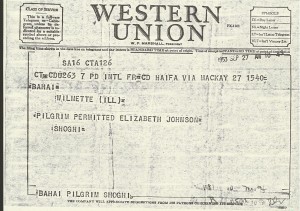
The telegram granting Elizabeth permission to come on pilgrimage

The privilege of making the pilgrimage to the holy places of one’s Faith was one of the highlights of Elizabeth’s life. This was especially true during the ministry of Shoghi Effendi, as pilgrimage also meant the inestimable bounty of meeting the man who was the direct descendant of Bahá’u’lláh and the family of the Báb, her spiritual leader, and infallible guide. She wrote to the Guardian in January, 1953, asking for permission to come on pilgrimage, and informing him of her intention to attend the Stockholm Conference that summer. The Guardian’s secretary replied to her in a letter dated in March, telling Elizabeth that, because of the long waiting list, it would not be possible for her to come to Haifa before the Conference, but that he would let her know when it would be possible to do so; and also expressing happiness with her intention to attend the Conference.  


            The request to go on pilgrimage went directly to the World Center in Haifa. The approval from Haifa went by cable to the National Spiritual Assembly, who in turn relayed the permission to Elizabeth. Permission to go on pilgrimage was granted in September and was for January, 1954. Late that month, Elizabeth received a letter from the Office of the Secretary of the National Spiritual Assembly, along with the cable from the Guardian. The economical text of the cable read simply, “PILGRIM PERMITTED ELIZABETH JOHNSON” and was signed “SHOGHI”. The letter from the National office was signed by the Secretary, Horace Holley, who was then also a Hand of the Cause of God. Elizabeth made her arrangements directly with Haifa, and she was granted approval, by cable, to leave for Haifa the middle of January.          


            One of the indications of how small the number of pilgrims was in the 1950’s, compared to today, and how few the number of followers of Bahá’u’lláh, is a letter sent to Elizabeth with regard to her travel arrangements. She planned to visit London on her return, and had written directly to the NSA of the British Isles for recommendations as to hotel accommodations. The National Spiritual Assembly sent her a five paragraph reply, nearly a full page, giving her several recommendations. It suggested, for example, trying the Alexa Hotel, noting that is the hotel where the NSA and Committee members often stay, but informing her that it does not have a lift. The friendly letter said that four pilgrims had just returned to their country, the first in many months, and they were anxiously waiting to hear what they had to say. The letter concluded by requesting that she let them know when and how long she would be in London, so that the friends there would be able to meet her and hear the comments of the Guardian. It was signed by the NSA Secretary, John Ferraby, who would be appointed a Hand of the Cause of God in 1957. The friends were always eager to hear the Guardian’s words, especially at this time, the beginning of the Ten Year Crusade.


            Elizabeth arrived in Israel on Monday morning, January 18, after what was surely a tiring journey. Air travel took much longer then because of the need for frequent refueling stops. She left New York the evening of the 16th, and made stops in Shannon, Paris, Zurich, Rome, and Athens (all on the same flight) en route to Tel Aviv.  She was certainly eager to get there, since she did not stay over at any of her stops! Upon settling at her hotel in Haifa, she cabled her husband, John, of her safe arrival.


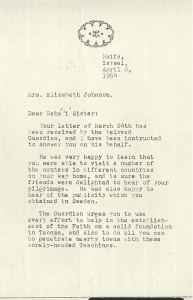
A letter from the Guardian, page 1


            Pilgrimage is a personal, intimate experience that cannot adequately be conveyed in words. Bahá’ís read the history of their Faith and the associations of their holy places in Akká and Haifa with the lives of Bahá’u’lláh, ‘Abdu’l-Bahá, their family, the remains of the Báb, and the many early believers. It becomes a part of every Bahá’í’s history. Pilgrims can walk where they walked and see what they saw. They can see how the holy places have been transformed and beautified under the Guardian’s care. And most of all, they can visit and pray at those most holy places, the resting spots of the Central Figures of their Faith. Elizabeth, like many pilgrims during the lifetime of the Guardian, left Pilgrim Notes of some of her experiences.


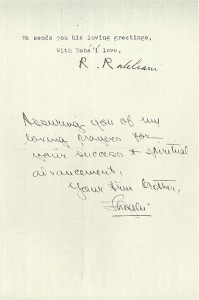
A letter from the Guardian, page 2


            She was a people person, and her Pilgrim Notes reflect that. She does not tell about her thoughts or emotions, or comment on her visits to the holy places or her sight-seeing trips. She talks about people she met – conversing with a Jewish man on the plane whose family had perished in the holocaust, and enjoying lunch at the Pilgrim House with Ruhiyyih Khanum, Sylvia Ioas, and Honor Kempton. Mostly, of course, she comments on her meeting Shoghi Effendi, the Guardian of the Bahá’í Faith. The Guardian regularly invited pilgrims to sit at the dinner table with him and with those who served him in Haifa – the members of the International Bahá’í Council and the Hands of the Cause. They would be privileged to hear the Guardian’s assistants share with him the news of the day’s labors and his advice and instructions to them for the next day. And, Shoghi Effendi would speak to the pilgrims directly, answering their questions, telling them what the Bahá’ís must do to promote the Word of God, and sharing with them his vision. It is these comments directed to the pilgrims that fill the brief pages of Elizabeth’s notes.


            Elizabeth’s thoughtfulness to others is revealed in the correspondence that followed her pilgrimage. She stopped in Rome on the way home and visited the Hand of the Cause Ugo Giachery and his wife, Angeline, at their home, where she also enjoyed visiting with Bahá’ís at a fireside and luncheon. Her warm letter to Mr. and Mrs. Giachery, thanking them for their hospitality, expressed her sorrow that they could not use the stockings that she left them, and she also says that she would like to know about the watch, hoping that it could be fixed. Who else would leave stockings and a watch to a Hand of the Cause and his wife?


            Jessie and Ethel Revell each wrote separate letters to her recalling her pilgrimage. Jessie writes, “After you left, there was a big vacancy here – we all miss you very much.” She goes on to say that she wore the scarf that Elizabeth gave her and that it was beautiful and a cheerful reminder of her. And she concludes by saying, “We miss your good cake and rolls, etc.”  Ethel wrote Elizabeth twice (both responses to her letters). One letter, written two years later while on vacation in Malta, comments on activities and people, and also says to Elizabeth, “Don’t worry about your not making an angel pie while you were in Haifa. What we did have of your baking was simply delicious.” How many pilgrims took the time to bake for the Guardian and his busy staff? Elizabeth must have left quite an impression with her baking, to be remembered so well two years later.


            Elizabeth was faithful to the Guardian in her teaching efforts in the Tacoma area. She wrote her (presumably) fourth and final letter to him in January, 1957, keeping him apprised of her efforts. The reply, by the Guardian’s Secretary (Hand of the Cause Leroy Ioas), expresses pleasure with her teaching work and asks her to write to the friends in Korea so that they may contact a master sergeant who became a Bahá’í through Elizabeth’s efforts. Mr. Ioas also tells her that the Guardian wishes her to continue her correspondence with the friends in Sweden, France, and the Faroe Islands. He concludes by reminding her that “Spiritual development comes through teaching the Faith, as it attracts the quickening power of the Holy Spirit.” Enclosed with the letter was a receipt for a contribution to the Fund, which was signed, as usual, “Shoghi”. Such was the burden on the Guardian, that he personally signed the many receipts even for modest contributions – but one can imagine the pleasure and confirming power bestowed on the happy contributor, to have the receipt so signed.


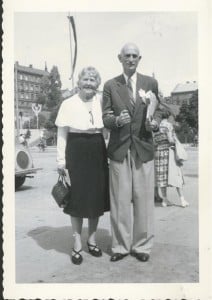
Hand of the Cause Ugo Giachery with his dear wife, Angeline, taken by Elizabeth at a conference in Stockholm in 1953.


Elizabeth received four letters from the Guardian’s secretaries on his behalf, in reply to her letters. The first three had a postscript in the handwriting of  Shoghi Effendi, which was something about which she was always proud. The first one was in reply to her request to go on pilgrimage. The Guardian wrote: “Assuring you of my loving prayers for your success in the service of our beloved Faith. Your true brother, Shoghi”.  The second letter was a follow-up to the first one, coming just one month later, informing Elizabeth that the Guardian knows nothing about a certain Dr. Amir Rouhi from Iran, that he is neither a Bahá’í nor related to Bahá’u’lláh, and that it is better to avoid him. We have no other information about this Dr. Rouhi or why Elizabeth would write to the Guardian about him – one suspects that the real reason was the desire to enjoy again the excitement of receiving a letter from the Guardian. The third letter came to Elizabeth after her pilgrimage and return home. The Guardian’s secretary expresses Shoghi Effendi’s happiness to learn that she was able to visit a number of centers in different countries on the way home and that she was able to obtain publicity for the Faith in Sweden. The letters goes on to say: “The Guardian urges you to use every effort to help in the establishment of the Faith on a solid foundation in Tacoma, and also to do all you can to penetrate nearby towns with these sorely-needed teachings.”


            That Elizabeth would receive personal responses to her letters gives us a very small hint at the great burden of work facing the Guardian and the small staff at the World Center in just reading and answering the correspondence. There were no computers then. Each letter had to be typed by hand. And, Shoghi Effendi would take the time to append a few personal words of encouragement to so many of the letters. This tells us something of the importance that he placed in the teaching efforts of each of the faithful followers of Bahá’u’lláh, that he would take the time to do this so regularly for so many years.

Early Tacoma Bahá’ís – Elizabeth Johnson, Part 1

Elizabeth Johnson at age 25

“It’s wonderful to be able to ask this kind of service and immediately get a ‘yes’ answer, and know it’s going to be done.” A life of devotion and service is summarized in

this line from a postscript of a letter, expressing personal and heartfelt appreciation for publicity arrangements made for a Bahá’í visitor.  Filed away, unseen and unknown, this “thank you” stands, for us, as  tribute to one of the homefront pioneers and founders of the Bahá’í Faith in Tacoma. Elizabeth Johnson, the latter half of her long life, served her Lord to sustain and build the religious community of her adopted town. She did the ordinary, unpretentious, little things that need to be done. She helped set up meetings for guest speakers. She wrote and delivered news items or announcements of events to the daily newspaper. She corresponded with pioneers of the Faith she had never met who were serving the Faith in places she had never been. She helped the ill and needy. 


            Little is know of the first half of Elizabeth’s life. Born Elizabeth Bergren in Sweden on June 4, 1895, she immigrated to the United States in 1916 and worked as a domestic servant in the homes of Chicago families. She was five feet six inches tall and had brown hair and blue eyes. We don’t know if she had family in the United States prior to her arrival, although years later she did have sisters living in Minneapolis.  Who her friends were, what she did in her leisure time, whether she had a boyfriend or loved someone, what her ambitions may have been and what her disappointments were: these important and personal aspects of the first forty-five years of her life we know nothing about. And, perhaps it does not matter that we don’t know. We all live with the struggles and pleasures and pains of life. What Elizabeth did have in her life that makes her worth remembering is that she came to recognize her Lord and spent her life serving Him and helping others. This began about 1940.


            That great and silent teacher of the Faith, the Temple in Wilmette (a suburb of Chicago) may have been what first attracted her curiosity to the Faith. She saw it being built a little at a time as the finances of the small North American Bahá’í community allowed. How she came to inquire about the Faith and what type of meeting she first attended, we don’t know. Her teacher was an early and well-known American believer, Albert Windust. But, her spiritual father, a man who remained special to her for the rest of her life, was Harvey Nied. 


            We have the following information from Elizabeth about her spiritual forebears. Harvey Nied entered the Faith about 1939, while living in Florida and making a living doing Swedish massage. He studied the Faith from Dr. Zia Bagdadi and later in Chicago from Albert Windust. In 1940 Mr. Nied became ill while attending a Bahá’í summer school in Flint, Michigan. After being first taken to a county hospital, he was transferred to a Veterans Affairs hospital for mental patients in Elgin, Illinois. Mr. Nied’s sister,

with help from Elizabeth, was able to have him released from the V.A. hospital so that he could receive treatment elsewhere, and also arranged for him to receive social security benefits. Elizabeth helped care for him on behalf of his legal guardian by taking him to the doctor, buying his clothes, and doing other little things for him to make his life more pleasant.   


            Elizabeth moved to Tacoma in 1943, and Mr. Nied (apparently afterward) moved to Portland, Oregon to work at a shipyard. Sometime later he was found in a mission in Seattle, unable to care for himself. He had a legal guardian from the LaSalle Bank who contacted Elizabeth and asked her to help find him. Apparently she did so, for in 1941 she was able to help him obtain a veteran’s pension of $40 per month. The LaSalle Bank served as the guardian of his money. This is a brief and incomplete history of two dear

friends. It does create questions. Presumably, Elizabeth left for the West Coast before Mr. Nied. Did Mr. Nied go to the West Coast because his friend, Elizabeth, was there? If he did, then why didn’t he go to Tacoma? And how was Elizabeth able to find him? We shall never know.


            Eventually, Harvey Nied was admitted into the V.A. hospital for mental patients near Tacoma (at American Lake in Lakewood, Washington). At one time he was boarded out to a family, but was re-admitted into the hospital after he walked away from them. He was moved to a nursing home in 1965, receiving a V.A. pension and social security, and spent the rest of his life in various nursing homes. Elizabeth (and her husband, John, until his passing) would go see him often and help care for him. For years, she did numerous things to make his life more comfortable: she brought him food, fed him when he could not feed himself, did his laundry, and washed him. Harvey Eugene Nied, born May 2, 1892, left this world on November 27, 1972, and following a funeral service in Tacoma was laid to rest at the Willamette National Cemetery in Oregon. 


            This brief account of the life of Harvey Nied, together with the fact that, late in her life, Elizabeth was motivated to record something for posterity about the man who was her spiritual father, tells us as much about Elizabeth as it does about Mr. Nied. She was devoted to him, and she loved and cared for the man who helped her find the Bahá’í Faith. Others were aware of her devotion. One friend, consoling her over Mr. Nied’s passing, wrote that “Though he was alone in the isolated world of the mind, he could not have had a more devoted friend to see him through than you, Elizabeth. For twenty-eight years you have been his only mainstay here in Tacoma, as I know. Only you understood what a gentle, well educated gentlemen, Harvey Nied was and only you, Elizabeth, understood in some spiritual way what bound you to him, to help and stand by him.”


Elizabeth with unidentified man. Possibly Chicago 1932.


            Elizabeth became a Bahá’í in 1941 or 1942, while living in Chicago. She left there in 1943 and moved to Tacoma to help with the teaching and proclamation efforts. She married John A. Johnson, a railroad employee, in Tacoma that same year, marrying for the first time (as far as we know) at age 48.  She did, however, maintain her ties to Chicago. She may have attended the Bahá’í Centenary Banquet in that city, because her papers include a program card from that banquet: guest speakers included Albert Windust and Elsie Austin. And, she visited her life-long friend from that area, Betty Edwards, in 1950, as indicated by a clipping from a mimeographed Bahá’í newsletter that she kept that referred to her visit.  Undated newspaper and magazine clippings, which may be from 1947, show her husband, John, a train fireman, dressed in white tie, tails, and top hat, posing proudly with the conductor and engineer on the new Olympian Hiawatha, a new passenger train that the reader is told will operate on a 45 hour schedule between Chicago and Seattle. Did John Johnson’s career have something to do with how he and Elizabeth met and why she decided to marry him? Did her marriage allow this frugal Swede to make trips to Chicago at a reduced fare? The decision to marry can be complex. One can only speculate.


            Elizabeth collected newspaper clippings about Bahá’í activities in Tacoma and elsewhere, especially during the late 1940’s and throughout the 1950’s. There are so many clippings, in fact, that she may have collected virtually every item that appeared in the newspaper about the Faith. Most of them probably got there because of her active work.

Elizabeth knew how to get things done. She often delivered some of her baked goods to the appropriate newspaper staff, along with that valuable item about the Faith, in order to enhance the likelihood of the item being published.


            The articles reveal her interest in and commitment to the affairs of the Faith. Here are some examples. The assassination of Count Folke Bernadotte (a nephew of the King of Sweden) in Jerusalem in September, 1948, where he was working to settle the Arab-Israeli dispute on behalf of the United Nations, provoked Elizabeth to write a letter about his death that appeared in Tacoma’s daily paper, The News Tribune. She writes several paragraphs condemning the senseless violence, and concludes by mentioning Bahá’u’lláh and quoting briefly from His Writings. Another example: the society column of the Tacoma newspaper for October 18, 1949, relates that the 130th anniversary of the Birth of the Báb will be held at her home on Thursday at 8 p.m. at 414 South Tacoma Avenue.  Also: The News Tribune’s June 6, 1955 edition carries an article about Elizabeth, as secretary of the Tacoma Bahá’ís, writing a letter to President Eisenhower asking him to use his influence to prevent further persecutions of Bahá’ís in Iran.  Many newspaper articles announce local holy day observances and guest speakers, and there are occasional letters to the editor by Elizabeth.


            She was not reluctant to defend her beloved homeland. Elizabeth was proud of her Swedish heritage. A letter to the editor appears in the August 3, 1949 Tacoma newspaper in which she defends her country against a perceived slight by an Anthony J. Corvin, made in another letter to the editor that appeared in the July 27 edition. The nature of the insult is not clear; apparently he said something uncomplimentary about the Italians, Irish, Jews, Slavs, and the Swedish people. Elizabeth was shocked, however, and her  proud defense is stirring, praising the Swedes’ cleanliness, healthful habits, thrift, and fresh food: “I was told in Chicago that travelers in Sweden found smorgasbord out of this world and parks very clean. You don’t have nerve to throw your cigaret in the parks. Swedish people don’t like installments on automobiles so they go bicycling. If you go to Stockholm, you find the 91-year-old King bicycling.”; and “Where in Sweden will you find vermin-ridden huts and sour soups.”  She concludes her patriotic defense by appealing to universal brotherhood, stating that “I am looking for a universal language, one common script, the unity of thought in world’s undertakings, the unity of religion, the unity of nations, the unity of races, making of all that dwell on earth, peoples and kindreds of one race.” That plain spokenness was characteristic of Elizabeth.