By Admin on May 3, 2010 in A Better World, Tacoma Baha'i | comments(0)

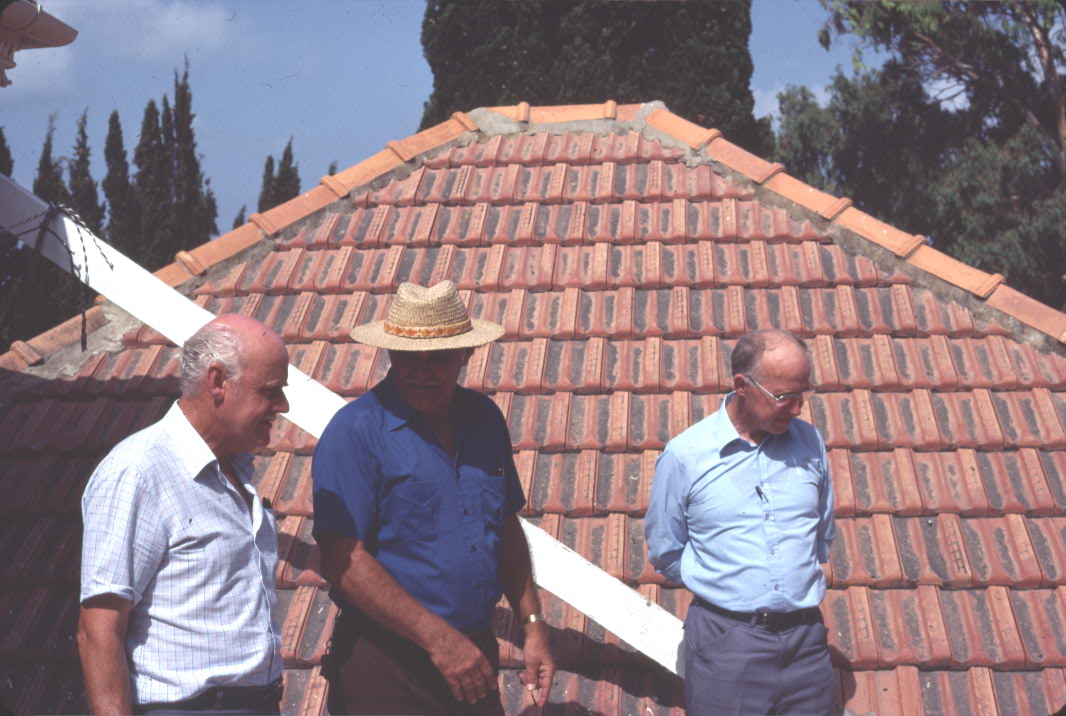
George Bowers (property manager), Phil Trutza (workshop foreman), and Denver Morgan (draughtsman) inspect the roof of the Shrine of Bahá’ulláh at Bahji, in northern Israel, during a restoration project in the mid-1980’s.
The twelfth Glad-Tidings
It is enjoined upon every one of you to engage in some form of occupation, such as crafts, trades and the like. We have graciously exalted your engagement in such work to the rank of worship unto God, the True One. Ponder ye in your hearts the grace and the blessings of God and render thanks unto Him at eventide and at dawn. Waste not your time in idleness and sloth. Occupy yourselves with that which profiteth yourselves and others. Thus hath it been decreed in this Tablet from whose horizon the day-star of wisdom and utterance shineth resplendent.
The most despised of men in the sight of God are those who sit idly and beg. Hold ye fast unto the cord of material means, placing your whole trust in God, the Provider of all means. When anyone occupieth himself in a craft or trade, such occupation itself is regarded in the estimation of God as an act of worship; and this is naught but a token of His infinite and all-pervasive bounty.
Bahá’u’lláh
By Admin on May 2, 2010 in A Better World, Tacoma Baha'i | comments(0)

Pudding, the ferret, lived in peace and harmony with both the dogs and cats in his family.
Bahá’u’lláh, in His Writing entitled Tarázát (Ornaments), reminds us all of the vital need for us to live together in harmony for our mutual benefit:
The second Taráz is to consort with the followers of all religions in a spirit of friendliness and fellowship, to proclaim that which the Speaker on Sinai hath set forth and to observe fairness in all matters.
They that are endued with sincerity and faithfulness should associate with all the peoples and kindreds of the earth with joy and radiance, inasmuch as consorting with people hath promoted and will continue to promote unity and concord, which in turn are conducive to the maintenance of order in the world and to the regeneration of nations. Blessed are such as hold fast to the cord of kindliness and tender mercy and are free from animosity and hatred.
This Wronged One exhorteth the peoples of the world to observe tolerance and righteousness, which are two lights amidst the darkness of the world and two educators for the edification of mankind. Happy are they who have attained thereto and woe betide the heedless.
O SON OF GLORY!
Be swift in the path of holiness, and enter the heaven of communion with Me. Cleanse thy heart with the burnish of the spirit, and hasten to the court of the Most High.
Bahá’u’lláh
By Admin on May 2, 2010 in A Better World, Tacoma Baha'i | comments(0)

James Marshall holds little Andy Morse at the Race Unity Day picnic in Fairbanks, Alaska in June 1983. Jim lived in interior Alaska much of his life and was a plumber by trade. He and his wife, Florence, were privileged to have several Hands of the Cause of God visit their home in Fairbanks during their world-wide travels on behalf of the Faith.
Bahá’u’lláh, in His Writing entitled Tarázát (Ornaments), reminds us of the need for us to know our true spiritual nature and of the importance of education and work:
The first Taráz and the first effulgence which hath dawned from the horizon of the Mother Book is that man should know his own self and recognize that which leadeth unto loftiness or lowliness, glory or abasement, wealth or poverty. Having attained the stage of fulfilment and reached his maturity, man standeth in need of wealth, and such wealth as he acquireth through crafts or professions is commendable and praiseworthy in the estimation of men of wisdom, and especially in the eyes of servants who dedicate themselves to the education of the world and to the edification of its peoples. They are, in truth, cup-bearers of the life-giving water of knowledge and guides unto the ideal way. They direct the peoples of the world to the straight path and acquaint them with that which is conducive to human upliftment and exaltation. The straight path is the one which guideth man to the dayspring of perception and to the dawning-place of true understanding and leadeth him to that which will redound to glory, honour and greatness.
We cherish the hope that through the loving-kindness of the All-Wise, the All-Knowing, obscuring dust may be dispelled and the power of perception enhanced, that the people may discover the purpose for which they have been called into being. In this Day whatsoever serveth to reduce blindness and to increase vision is worthy of consideration. This vision acteth as the agent and guide for true knowledge. Indeed in the estimation of men of wisdom keenness of understanding is due to keenness of vision. The people of Bahá must under all circumstances observe that which is meet and seemly and exhort the people accordingly.
O SON OF MAN!
Rejoice in the gladness of thine heart, that thou mayest be worthy to meet Me and to mirror forth My beauty.
Bahá’u’lláh
By Admin on May 2, 2010 in A Better World, Tacoma Baha'i | comments(0)
 Courtesy of Médiathèque baha’ie at www.bahai-biblio.org.
Bahá’u’lláh, in His tablet, Bishárát (Glad-Tidings), says this:
The third Glad-Tidings concerneth the study of divers languages. This decree hath formerly streamed forth from the Pen of the Most High: It behoveth the sovereigns of the world — may God assist them — or the ministers of the earth to take counsel together and to adopt one of the existing languages or a new one to be taught to children in schools throughout the world, and likewise one script. Thus the whole earth will come to be regarded as one country. Well is it with him who hearkeneth unto His Call and observeth that whereunto he is bidden by God, the Lord of the Mighty Throne.
This counsel is revealed in several of His Writings. He entirely leaves the choice up to others. Adib Taherzadeh, in The Revelation of Bahá’u’lláh, Volume 4, refers to this, and then says this about another of His Writings:
It is interesting to note that in the Tablet of Bisharat Bahá’u’lláh enjoins upon the governments of the world to adopt the international language. These two statements, which seem to be contradictory, may be regarded as two different stages in bringing about a world auxiliary language. The first stage will be the adoption of a universal language by the governments, while the second will have to wait until such time that the Universal House of Justice has emerged as the supreme institution of the World Order of Bahá’u’lláh and its authority is recognized. It is only then that it can possibly reconsider the choice of the language so as to either retain the one chosen by the governments or alter it altogether.
In one of His Tablets revealed in ‘Akká, Bahá’u’lláh emphasizes the importance of adopting the auxiliary international language ordained in the Kitáb-i-Aqdas. He states that its implementation will provide a means for safeguarding the unity of the human race and will facilitate intercourse and understanding among the peoples of the world. In this Tablet Bahá’u’lláh praises the Arabic language for its expressiveness and eloquence, and remarks that no other language can match its vast possibilities. He further states that God would be pleased if all the peoples of the world were to speak the Arabic language. But He does not require humanity necessarily to adopt it as the international language; rather He leaves the choice to the appropriate institutions.
~
O SON OF BEING!
Make mention of Me on My earth, that in My heaven I may remember thee, thus shall Mine eyes and thine be solaced.
Bahá’u’lláh
By Admin on Apr 26, 2010 in Tacoma Baha'i | comments(0)

April lilacs in Tacoma announce that spring has arrived.
The kingdom of Heaven resembles the year. As the year has four seasons, so also the kingdom
, and remember that the seasons are caused by
the movement of the earth, and not by the movement of the sun.
Before the coming of the spring, the earth looks as if dead and lifeless, but when it appears,
all the world seems to spring into life and brightness — into a new existence of beauty and joy.
All nature is clad in fresh green, the grass springs up, the leaves bud, and the trees are
covered with blossoms. But the spring passes, and then comes the summer, in which the promise
of the spring is fulfilled; the spring blossoms ripen into fruit, and the fields are covered with
yellow grain; the result of the new life of the spring is manifested. Then comes the autumn,
in which the life of the spring and summer begins slowly to fade, and finally winter
comes round, and the life of the earth seems to be completely extinct — dead.
So it is also in the spiritual things. The cycle of every prophet has its period of spring, of
summer, of autumn and of winter. When Moses appeared, and the new Life and Light of
God shone on the earth through him, the people to whom he came were as dead souls — without
life. But when he gave his teaching, then began the spring time of souls, and they awoke
into life, full of joy and beauty. Afterwards came the period of their summertime when the
lives of these followers of Moses had become gradually fashioned and moulded by his teachings,
and the fruit of his labors appeared. But after a time, hearts became heavy, faith grew
slack, and the people gradually lost the truth and reality of the revelation of their great teacher,
and then presently the period of their winter came, when they grew corrupted by outer
influences, and were as dead, without fruits and without life.
Then came the spring time of the revelation of Jesus Christ, which also, in its cycle, passed
through the periods of rise, fullness, decline and fall, until, at the time of the appearance of Mohammed,
the people were as dead — given over to materialities and dogmas, having lost the truth of the revelation of the Manifested Word.
So too, with the revelation of Mohammed, it also passed through these same conditions, till,
when the Blessed Perfection appeared, again the time of spring came to this earth, and to souls
enveloped and shrouded in darkness, a new season of life and joy and gladness begin. (The
people that walked in darkness have seen a great light; they that dwelt in the land of the
shadow of death, upon them hath the light shined.)
That passage of the Old Testament in which it is said that Jerusalem shall go into the wilderness,
could not mean that the city of Palestine should be removed into the wilderness — no, it
means that a new Revelation of God should appear in the wilderness, which took place when
Mohammed preached to those wild tribes in the desert — savage, uncivilized people as they were.
But always, when the word of God is manifested, the eyes of the spiritually blind are
opened, the ears that were deaf to the Voice of the Holy Spirit, are at last unsealed; those who
were crippled in the powers of their soul, become strong; the lame man leaps as an hart, and
the tongue of the dumb shall sing the praises of God.
By Admin on Apr 19, 2010 in Tacoma Baha'i | comments(0)

Photo courtesy of Médiathèque baha’ie at www.bahai-biblio.org.
Rejoice with exceeding gladness, O people of Bahá, as ye call to remembrance the Day of supreme felicity, the Day whereon the Tongue of the Ancient of Days hath spoken, as He departed from His House, proceeding to the Spot from which He shed upon the whole of creation the splendors of His name, the All-Merciful. God is Our witness. Were We to reveal the hidden secrets of that Day, all they that dwell on earth and in the heavens would swoon away and die, except such as will be preserved by God, the Almighty, the All-Knowing, the All-Wise.
Bahá’u’lláh
~
He Who is the Eternal Truth hath, from the Day Spring of Glory, directed His eyes towards the people of Bahá, and is addressing them in these words: “Address yourselves to the promotion of the well-being and tranquillity of the children of men. Bend your minds and wills to the education of the peoples and kindreds of the earth, that haply the dissensions that divide it may, through the power of the Most Great Name, be blotted out from its face, and all mankind become the upholders of one Order, and the inhabitants of one City. Illumine and hallow your hearts; let them not be profaned by the thorns of hate or the thistles of malice. Ye dwell in one world, and have been created through the operation of one Will. Blessed is he who mingleth with all men in a spirit of utmost kindliness and love.”
Bahá’u’lláh
~
Consider the pettiness of men’s minds. They ask for that which injureth them, and cast away the thing that profiteth them. They are, indeed, of those that are far astray. We find some men desiring liberty, and priding themselves therein. Such men are in the depths of ignorance.
Liberty must, in the end, lead to sedition, whose flames none can quench. Thus warneth you He Who is the Reckoner, the All-Knowing. Know ye that the embodiment of liberty and its symbol is the animal. That which beseemeth man is submission unto such restraints as will protect him from his own ignorance, and guard him against the harm of the mischief-maker. Liberty causeth man to overstep the bounds of propriety, and to infringe on the dignity of his station. It debaseth him to the level of extreme depravity and wickedness.
Regard men as a flock of sheep that need a shepherd for their protection. This, verily, is the truth, the certain truth. We approve of liberty in certain circumstances, and refuse to sanction it in others. We, verily, are the All-Knowing.
Say: True liberty consisteth in man’s submission unto My commandments, little as ye know it. Were men to observe that which We have sent down unto them from the Heaven of Revelation, they would, of a certainty, attain unto perfect liberty. Happy is the man that hath apprehended the Purpose of God in whatever He hath revealed from the Heaven of His Will, that pervadeth all created things. Say: The liberty that profiteth you is to be found nowhere except in complete servitude unto God, the Eternal Truth. Whoso hath tasted of its sweetness will refuse to barter it for all the dominion of earth and heaven.
Bahá’u’lláh