In Asian culture the dragon is a symbol of power, strength, good luck, and protection.
O my God, my Master, the Goal of my desire! This, Thy servant, seeketh to sleep in the shelter of Thy mercy, and to repose beneath the canopy of Thy grace, imploring Thy care and Thy protection.
I beg of Thee, O my Lord, by Thine eye that sleepeth not, to guard mine eyes from beholding aught beside Thee. Strengthen, then, their vision that they may discern Thy signs, and behold the Horizon of Thy Revelation. Thou art He before the revelations of Whose omnipotence the quintessence of power hath trembled.
No God is there but Thee, the Almighty, the All-Subduing, the Unconditioned.
Bahá’u’lláh
Artwork is courtesy of Amplified Clothing at www.amplifiedclothing.com/

Badí exemplified so many virtuous qualities, including courage, good character, self-sacrifice, love, and trustworthiness. This seventeen-year-old youth begged Bahá’u’lláh for the privilege of delivering a written message from Bahá’ulláh to the Shah of Iran, a mission that he knew would cost him his life. Here, he is shown in the hands of his jailers, torturers, and executioners following his accomplishment of that mission, and shortly before his death.
The fourth Taráz (Ornament) concerneth trustworthiness. Verily it is the door of security for all that dwell on earth and a token of glory on the part of the All-Merciful. He who partaketh thereof hath indeed partaken of the treasures of wealth and prosperity. Trustworthiness is the greatest portal leading unto the tranquillity and security of the people. In truth the stability of every affair hath depended and doth depend upon it. All the domains of power, of grandeur and of wealth are illumined by its light.
Not long ago these sublime words were revealed from the Pen of the Most High:
‘We will now mention unto thee Trustworthiness and the station thereof in the estimation of God, thy Lord, the Lord of the Mighty Throne. One day of days We repaired unto Our Green Island. Upon Our arrival, We beheld its streams flowing, and its trees luxuriant, and the sunlight playing in their midst. Turning Our face to the right, We beheld what the pen is powerless to describe; nor can it set forth that which the eye of the Lord of Mankind witnessed in that most sanctified, that most sublime, that blest, and most exalted Spot. Turning, then, to the left We gazed on one of the Beauties of the Most Sublime Paradise, standing on a pillar of light, and calling aloud saying: “O inmates of earth and heaven! Behold ye My beauty, and My radiance, and My revelation, and My effulgence. By God, the True One! I am Trustworthiness and the revelation thereof, and the beauty thereof. I will recompense whosoever will cleave unto Me, and recognize My rank and station, and hold fast unto My hem. I am the most great ornament of the people of Baha, and the vesture of glory unto all who are in the kingdom of creation. I am the supreme instrument for the prosperity of the world, and the horizon of assurance unto all beings.” Thus have We sent down for thee that which will draw men nigh unto the Lord of creation.’
Bahá’u’lláh
Photo from The Revelation of Bahá’u’lláh, Volume 3, by Adib Taherzadeh.

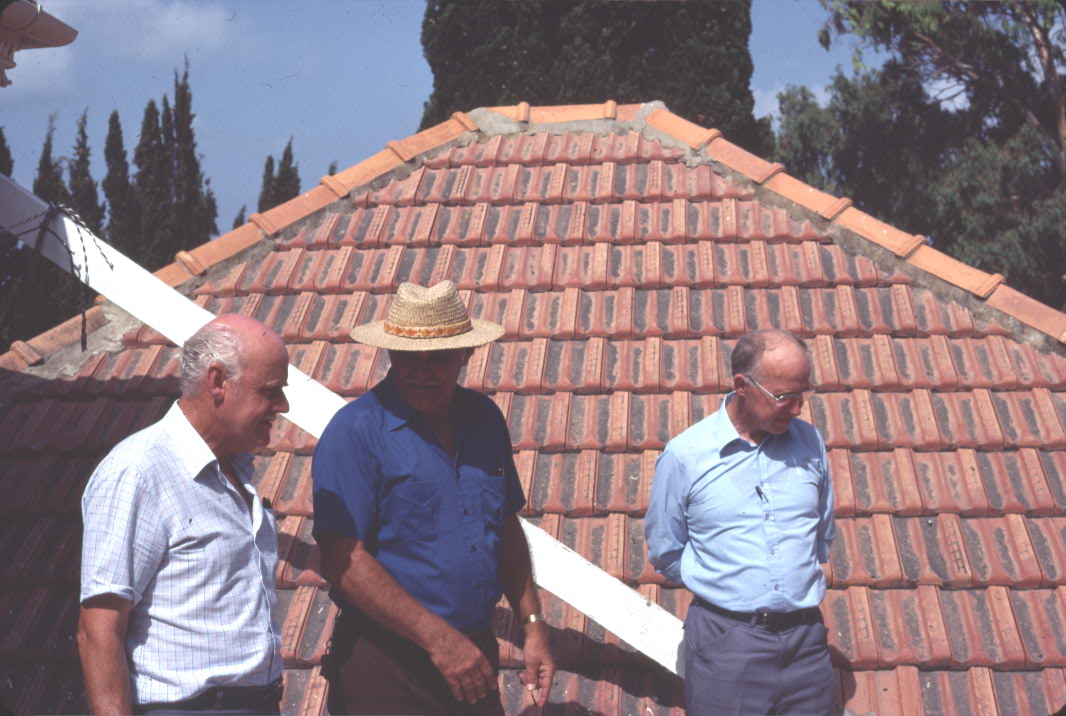
George Bowers (property manager), Phil Trutza (workshop foreman), and Denver Morgan (draughtsman) inspect the roof of the Shrine of Bahá’ulláh at Bahji, in northern Israel, during a restoration project in the mid-1980’s.
The twelfth Glad-Tidings
It is enjoined upon every one of you to engage in some form of occupation, such as crafts, trades and the like. We have graciously exalted your engagement in such work to the rank of worship unto God, the True One. Ponder ye in your hearts the grace and the blessings of God and render thanks unto Him at eventide and at dawn. Waste not your time in idleness and sloth. Occupy yourselves with that which profiteth yourselves and others. Thus hath it been decreed in this Tablet from whose horizon the day-star of wisdom and utterance shineth resplendent.
The most despised of men in the sight of God are those who sit idly and beg. Hold ye fast unto the cord of material means, placing your whole trust in God, the Provider of all means. When anyone occupieth himself in a craft or trade, such occupation itself is regarded in the estimation of God as an act of worship; and this is naught but a token of His infinite and all-pervasive bounty.
Bahá’u’lláh

Pudding, the ferret, lived in peace and harmony with both the dogs and cats in his family.
Bahá’u’lláh, in His Writing entitled Tarázát (Ornaments), reminds us all of the vital need for us to live together in harmony for our mutual benefit:
The second Taráz is to consort with the followers of all religions in a spirit of friendliness and fellowship, to proclaim that which the Speaker on Sinai hath set forth and to observe fairness in all matters.
They that are endued with sincerity and faithfulness should associate with all the peoples and kindreds of the earth with joy and radiance, inasmuch as consorting with people hath promoted and will continue to promote unity and concord, which in turn are conducive to the maintenance of order in the world and to the regeneration of nations. Blessed are such as hold fast to the cord of kindliness and tender mercy and are free from animosity and hatred.
This Wronged One exhorteth the peoples of the world to observe tolerance and righteousness, which are two lights amidst the darkness of the world and two educators for the edification of mankind. Happy are they who have attained thereto and woe betide the heedless.
O SON OF GLORY!
Be swift in the path of holiness, and enter the heaven of communion with Me. Cleanse thy heart with the burnish of the spirit, and hasten to the court of the Most High.
Bahá’u’lláh

James Marshall holds little Andy Morse at the Race Unity Day picnic in Fairbanks, Alaska in June 1983. Jim lived in interior Alaska much of his life and was a plumber by trade. He and his wife, Florence, were privileged to have several Hands of the Cause of God visit their home in Fairbanks during their world-wide travels on behalf of the Faith.
Bahá’u’lláh, in His Writing entitled Tarázát (Ornaments), reminds us of the need for us to know our true spiritual nature and of the importance of education and work:
The first Taráz and the first effulgence which hath dawned from the horizon of the Mother Book is that man should know his own self and recognize that which leadeth unto loftiness or lowliness, glory or abasement, wealth or poverty. Having attained the stage of fulfilment and reached his maturity, man standeth in need of wealth, and such wealth as he acquireth through crafts or professions is commendable and praiseworthy in the estimation of men of wisdom, and especially in the eyes of servants who dedicate themselves to the education of the world and to the edification of its peoples. They are, in truth, cup-bearers of the life-giving water of knowledge and guides unto the ideal way. They direct the peoples of the world to the straight path and acquaint them with that which is conducive to human upliftment and exaltation. The straight path is the one which guideth man to the dayspring of perception and to the dawning-place of true understanding and leadeth him to that which will redound to glory, honour and greatness.
We cherish the hope that through the loving-kindness of the All-Wise, the All-Knowing, obscuring dust may be dispelled and the power of perception enhanced, that the people may discover the purpose for which they have been called into being. In this Day whatsoever serveth to reduce blindness and to increase vision is worthy of consideration. This vision acteth as the agent and guide for true knowledge. Indeed in the estimation of men of wisdom keenness of understanding is due to keenness of vision. The people of Bahá must under all circumstances observe that which is meet and seemly and exhort the people accordingly.
O SON OF MAN!
Rejoice in the gladness of thine heart, that thou mayest be worthy to meet Me and to mirror forth My beauty.
Bahá’u’lláh